
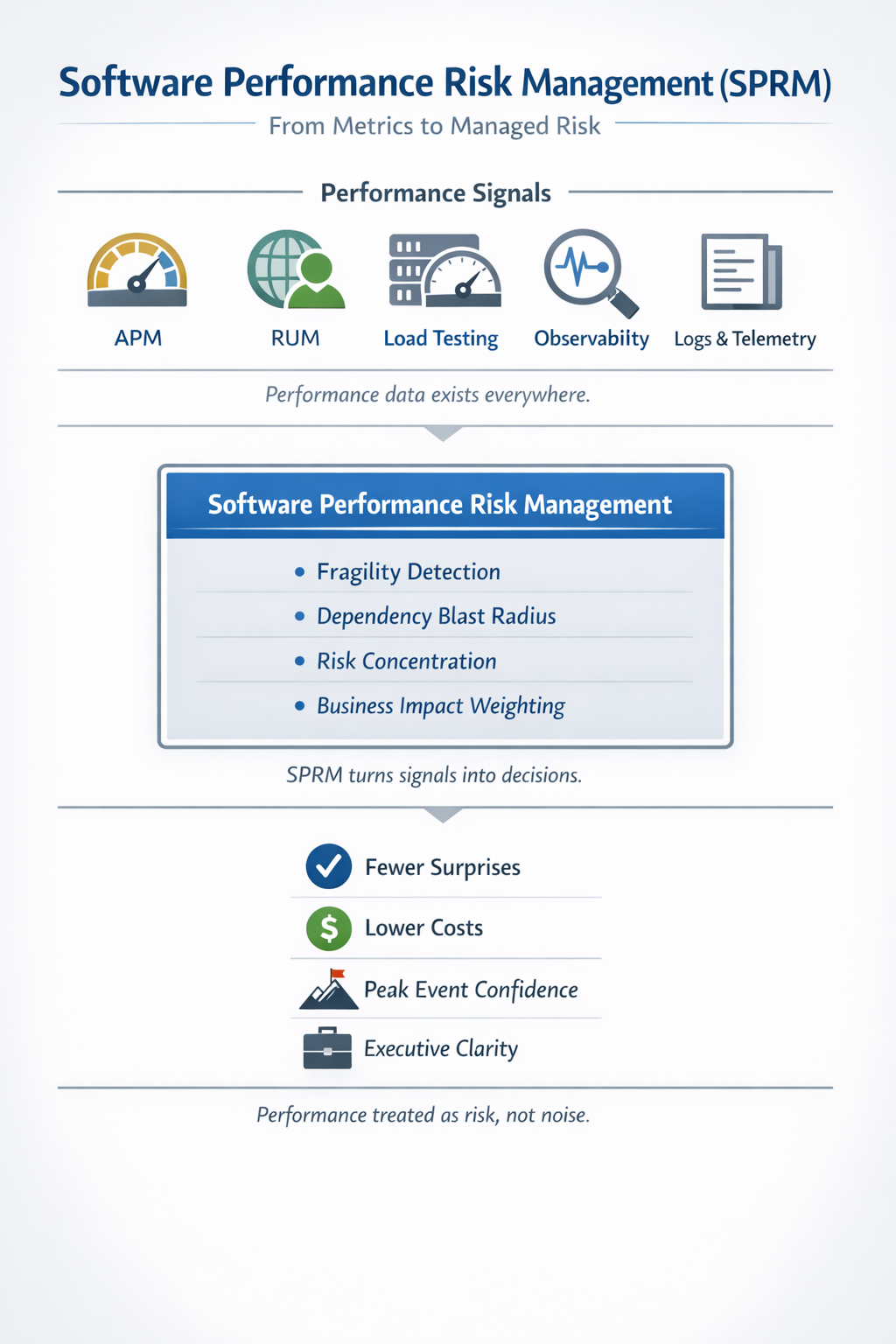
SPRM
Every new discipline faces the same initial reaction:
“Isn’t this just APM with a different name?”
“Isn’t this observability rebranded?”
“Don’t we already do this?”
Software Performance Risk Management (SPRM) exists precisely because those questions keep coming up — and because none of today’s tools answer them.
What today’s performance tools do well
Modern performance tooling is powerful.
APM pinpoints slow code paths and service bottlenecks
RUM captures real user experience in production
Load testing validates capacity and scaling assumptions
Observability reconstructs failures across distributed systems
These tools are essential.
They answer technical questions extremely well.
But they were never designed to answer management questions.
The questions no dashboard answers
When systems fail under stress, leaders don’t ask for percentiles or flame graphs.
They ask:
What is fragile right now?
Where is our largest blast radius?
Which dependency failure would hurt us most?
What should we fix before the next critical event?
Dashboards explain what happened.
They do not govern what matters next.
That gap is where SPRM lives.
SPRM is a decision layer, not a data source
SPRM does not replace existing tools.
It sits above them.
SPRM:
ingests signals from APM, RUM, testing, logs, and telemetry
normalizes them into risk indicators
evaluates fragility and dependency concentration
maps exposure to business impact
produces prioritized action
Think of SPRM as a control plane — not another dashboard.
Observability provides visibility.
SPRM provides governance.
How SPRM fits into the IT ecosystem
| Discipline | Primary Focus | SPRM Relationship |
|---|---|---|
| APM | Code & services | Signal source |
| RUM | User experience | Impact validation |
| Load testing | Capacity | Risk input |
| Observability | Forensics | Evidence |
| SPRM | Risk & prioritization | Decision layer |
SPRM does not compete with tools.
It makes them actionable at scale.
Who benefits — and why it matters
SREs reduce surprise incidents
Operations teams plan safely instead of reacting
Engineering leaders prioritize fixes with confidence
Executives understand exposure without technical noise
For the first time, performance conversations move from:
“Why did this happen?”
to
“Why didn’t we see this coming?”
The shift that’s underway
Security went through this transition years ago.
It moved from:
tools → controls
alerts → governance
incidents → managed risk
Performance is now following the same path.
Software Performance Risk Management is how that transition happens.
In the final article of this series, I’ll explain why SPRM is becoming unavoidable — and why performance risk is now a board-level concern.