
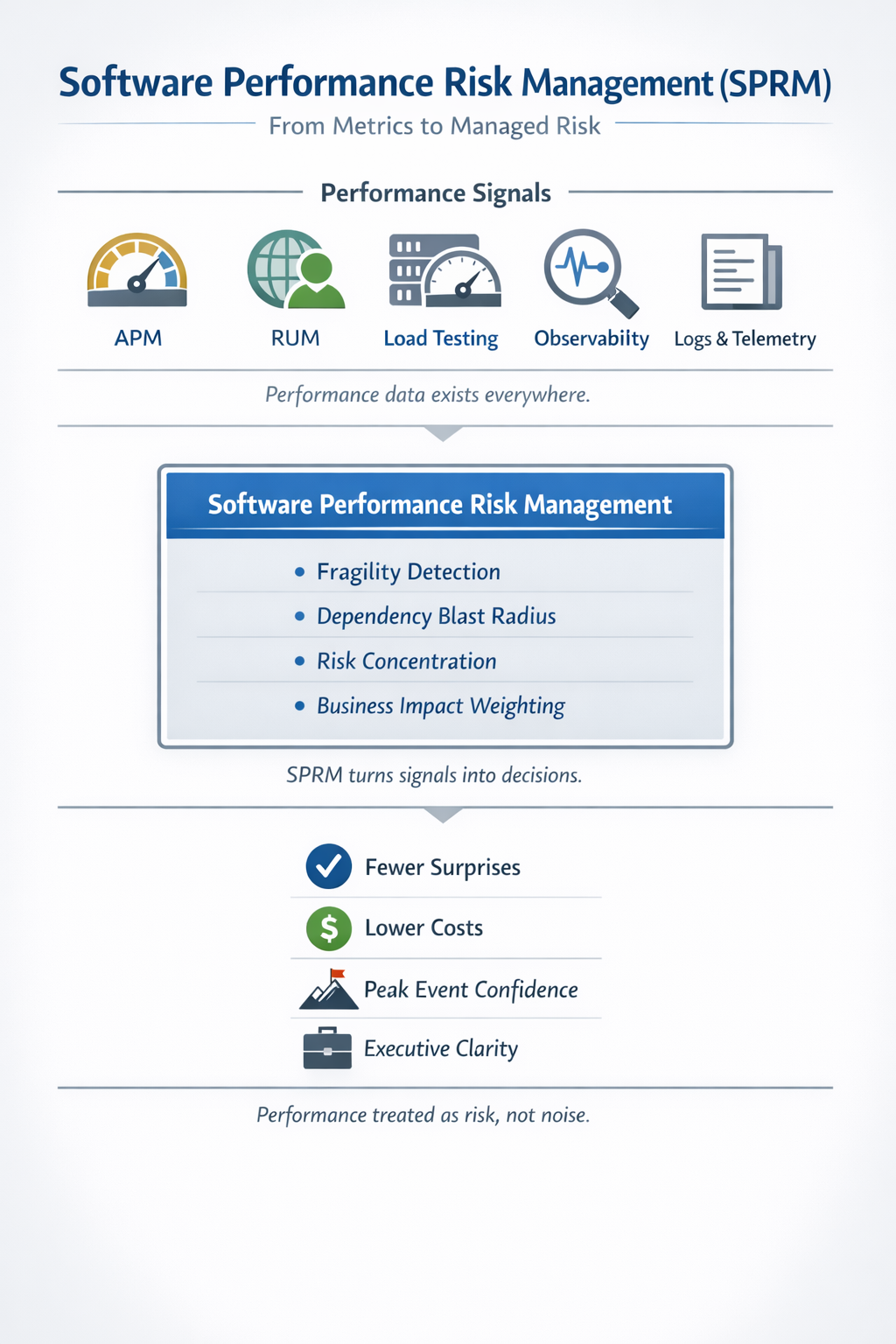
For decades, software performance has been treated as a technical optimization problem.
Make it faster. Tune it later. Test it before launch. Scale when it hurts.
And when things went wrong, we called it a performance issue.
That framing was always wrong.
Performance failures are not accidents
Most performance incidents are not caused by traffic spikes, bad luck, or “unexpected usage.”
They are the result of:
- architectural decisions made months earlier
- fragile dependency chains
- unexamined third-party integrations
- silent performance debt accumulating over time
When systems fail under load, they are doing exactly what they were designed to do — just not what the business expected.
Why “performance testing” never saved us
The industry bet heavily on testing and tooling.
Load tests validated capacity. APM tools explained slow code. Dashboards showed metrics.
And yet:
- outages still surprise teams
- peak events still cause panic
- slowdowns still bleed revenue without alarms
Why?
Because testing answers “can it handle this?” Risk management answers “what will break, when, and why?”
Performance was never managed as risk.
Every other critical domain learned this lesson
Security stopped being “pen testing” and became risk management. Finance stopped being bookkeeping and became risk management. Operations stopped being uptime tracking and became risk management.
Performance never made that transition.
So organizations accumulated:
- invisible exposure
- concentrated blast radius
- false confidence based on green dashboards
Until production proved otherwise.
Introducing Software Performance Risk Management (SPRM)
Software Performance Risk Management is the discipline of:
- identifying fragile components before failure
- understanding dependency-driven blast radius
- prioritizing remediation by business impact
- reducing surprise, not just mean response time
SPRM is not about making systems faster.
It is about making failure predictable, explainable, and preventable.

Why this matters now
Modern systems are no longer monoliths.
They are ecosystems:
- CDNs
- DNS providers
- identity platforms
- analytics scripts
- payment processors
- third-party APIs
Each integration improves velocity — and multiplies exposure.
Performance risk is no longer localized. It is systemic.
And unmanaged systemic risk always surfaces at the worst possible moment.
The shift that must happen
The question is no longer:
“How fast is the system?”
The question is:
“Where are we exposed, and what is the cost of ignoring it?”
That is the question Software Performance Risk Management exists to answer.
This is the origin of SPRM. The next articles will explain what it delivers, how it fits, and why it’s becoming unavoidable.