
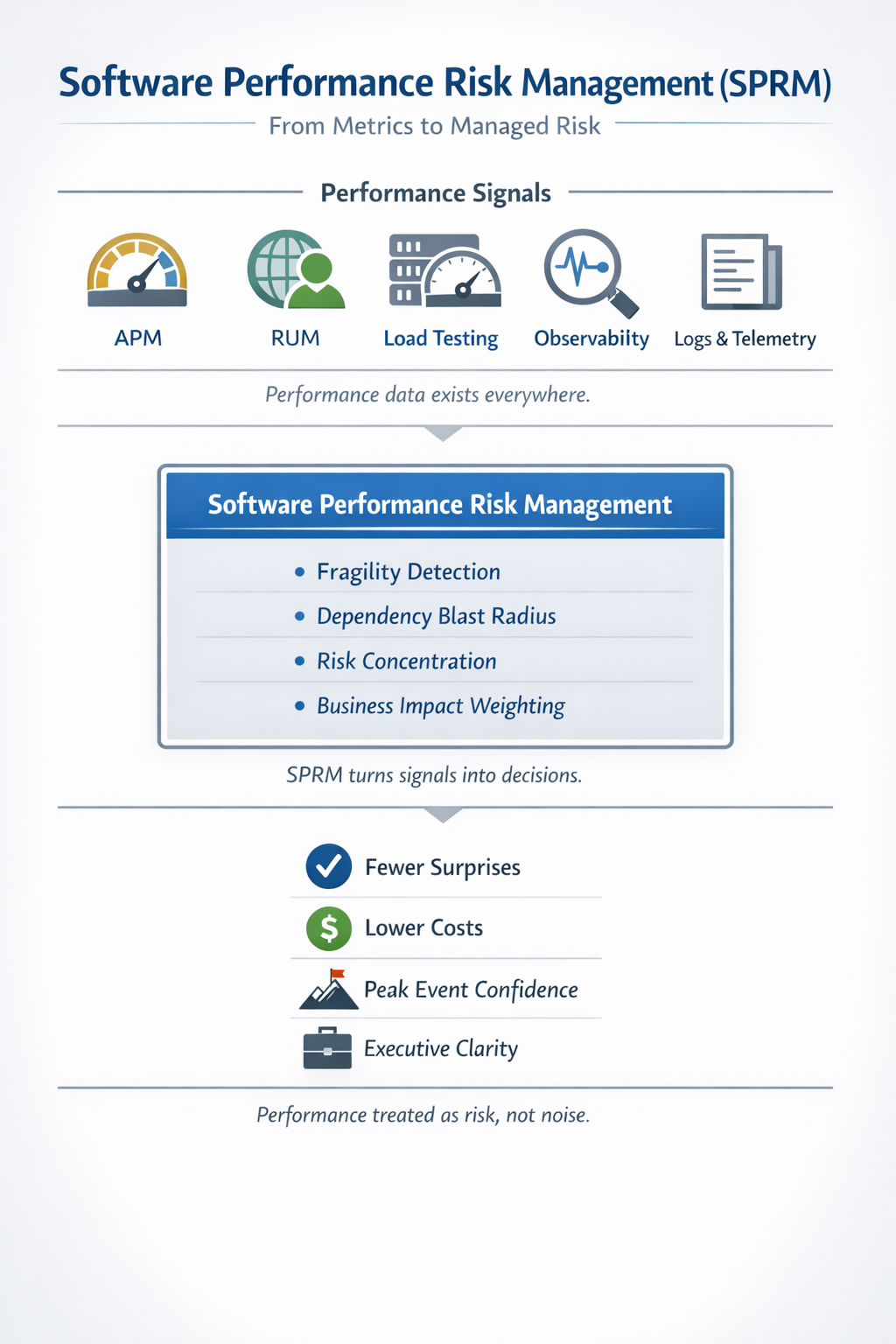
Software Performance Risk Management
Most performance failures don’t look like failures.
They look like:
- slightly slower checkouts
- intermittent API delays
- rising infrastructure bills
- unexplained conversion drops
- customer frustration without tickets
Nothing is “down.” Nothing pages the team. And nothing gets fixed.
That’s the real cost of unmanaged software performance risk.
Performance risk hides better than security risk
A security breach is loud. A performance failure is quiet.
Customers don’t report slowness. They abandon it. They don’t escalate degradation. They lose trust.
By the time leadership sees the impact—lost revenue, brand damage, churn—the technical cause is already buried under months of architectural decisions and accumulated performance debt.
The invisible tax every system pays
Unmanaged performance risk creates a permanent, compounding tax on the business:
- Overprovisioned infrastructure “just to be safe”
- Emergency fixes that harden fragility instead of removing it
- Peak-event anxiety instead of confidence
- Engineering cycles spent firefighting instead of building
None of this appears on a dashboard labeled risk. It appears as cost, delay, and organizational drag.

Why dashboards don’t prevent failures
Modern tooling is powerful—and incomplete.
APM explains slow code paths. RUM shows user experience. Observability reconstructs failures.
But none of them answer the questions executives actually care about:
- What is fragile right now?
- Where is our largest blast radius?
- What will fail first under stress?
- What should we fix before it hurts us?
Dashboards explain what happened. They do not govern what matters next.
Software Performance Risk Management changes the question
Software Performance Risk Management (SPRM) reframes performance from optimization to exposure.
Instead of asking:
“How fast is the system?”
SPRM asks:
“Where are we exposed, and what is the cost of ignoring it?”
SPRM focuses on:
- fragility, not averages
- dependency risk, not isolated services
- impact, not raw metrics
- prevention, not post-mortems
It turns performance data into prioritized decisions.
The business payoff
Organizations that manage performance risk see measurable outcomes:
- fewer surprise incidents
- lower infrastructure and CDN spend
- predictable behavior during peak demand
- restored executive trust in engineering
Most companies don’t have performance problems.
They have performance blind spots.
And blind spots are expensive.
In the next article, I’ll explain where Software Performance Risk Management fits into the existing IT ecosystem—and why it doesn’t replace your tools, but finally makes them governable.