
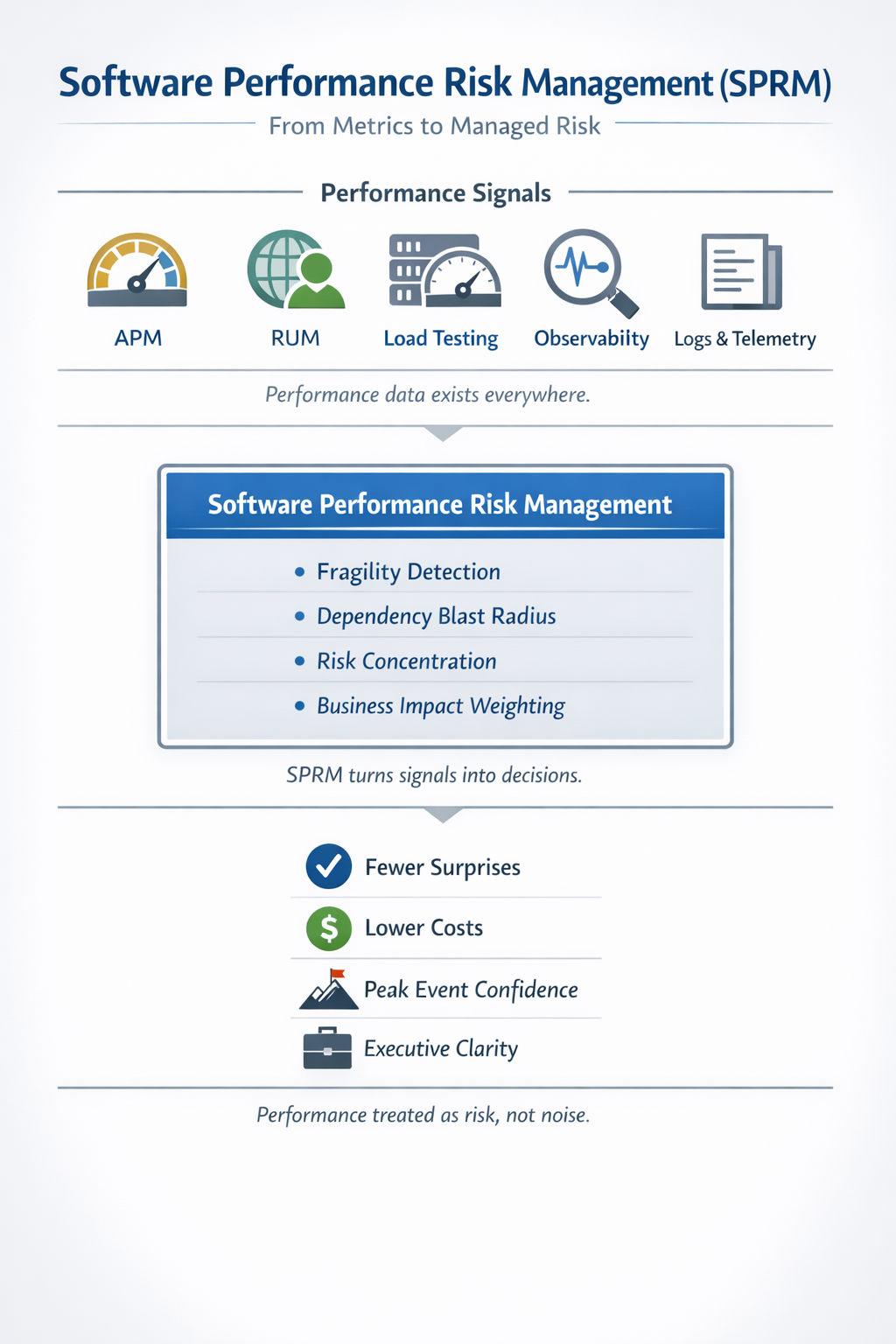
Modern software systems are faster than ever.
They are also more fragile than most organizations are willing to admit.
That fragility is why Software Performance Risk Management (SPRM) is no longer optional.
Performance risk has become systemic
Performance failures used to be localized:
- a slow database
- an inefficient query
- an overloaded server
Today, performance failures propagate.
Modern systems depend on:
- CDNs and DNS providers
- identity and authentication services
- certificate chains and trust anchors
- analytics, ads, and tag managers
- third-party APIs and SaaS platforms
Each dependency improves delivery speed.
Each one concentrates risk.
Failure no longer looks like an outage.
It looks like partial degradation at scale.
That is systemic risk.
Partial failure is the most dangerous failure mode
When systems fail partially:
- users experience friction, not errors
- revenue degrades silently
- trust erodes without alarms
- engineering lacks a clear incident trigger
These failures are harder to detect, harder to explain, and far more damaging over time.
They are also entirely predictable—if risk is being managed.
“We didn’t know” is no longer an acceptable answer
Security teams learned this lesson years ago.
Boards no longer accept:
- “it wasn’t tested”
- “it was a third party”
- “the dashboard was green”
As systems grow more interconnected, leaders now ask:
- Where are we exposed?
- What is our blast radius?
- What happens under peak conditions?
- Which failures would hurt us most?
Those are risk questions—not performance questions.
The SPRM maturity gap
Most organizations believe they manage performance risk.
In reality, most are stalled at visibility, not control.
- Dashboards show metrics
- Alerts fire after impact
- Post-mortems explain the past
Very few organizations can answer:
“What should we fix now to reduce future performance risk?”
SPRM exists to close that gap.
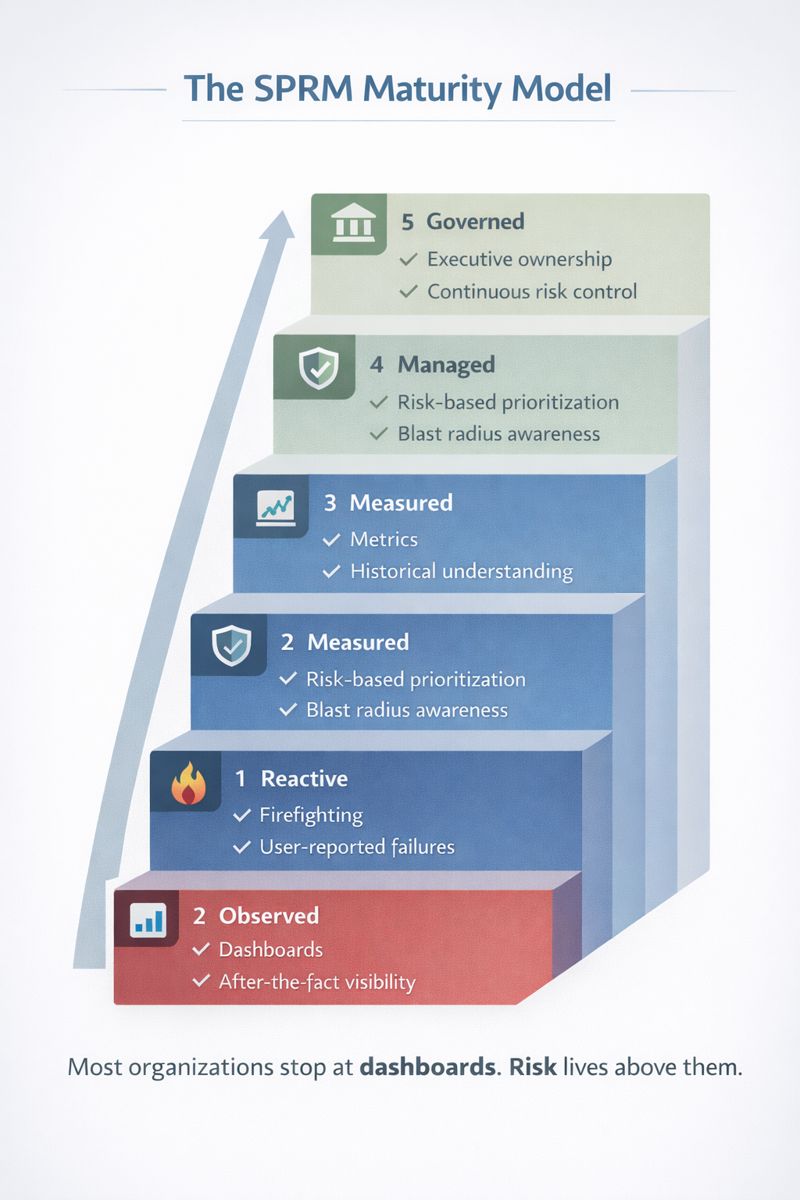
From firefighting to governance
Software Performance Risk Management moves organizations through a clear progression:
- Reactive → firefighting
- Observed → dashboards
- Measured → metrics
- Managed → risk-based prioritization
- Governed → executive ownership
Only at the highest levels does performance stop being a surprise.
That’s not an engineering problem.
That’s a management discipline.
The future of performance
The future of performance is not:
- faster benchmarks
- larger dashboards
- more alerts
The future is:
- fewer surprises
- controlled exposure
- predictable outcomes during critical moments
Performance is no longer a tuning exercise.
It is a business risk—
and it must be managed as such.
This is Software Performance Risk Management.